
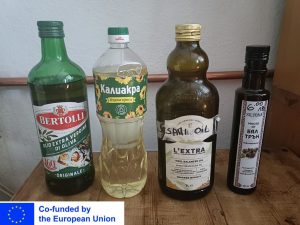
As an Italian, olive oil has always been a must on my everyday table. Even if it’s expensive, I couldn’t imagine a meal without it.
Since September 2024 my culinary habits strongly changed in Bulgaria, living in the world of permaculture. I still use olive oil, but less frequently and not in every meal. Also, I consume it mostly raw.
In this period I indeed deeply questioned the healthiness of vegetables oils. Do they provide more benefits or problems to your health? Here are a few tips to choose wisely how to consume them:
- Omega-3 and omega-6 1:1 ratio
It is important to keep the ratio 1:1 between omega-3 and omega-6 for your health.
Some vegetable oils are rich of omega-3 (which is good for the cardiovascular system, the joints, the cognitive functions, etc). In this regard, avocado oil, flaxseed oil and chia seed oil are all excellent choices. Nevertheless, it’s better to consume flaxseed and chia seed raw and grinded.
By contrast, some plant oils contain omega-6 instead of omega-3, for example corn oil, sunflower oil, peanut oil and sesame oil.
This ratio in the Western diet has shifted dramatically and seems to be as high as 20:1.
Scientists have hypothesized that too much omega-6 relative to omega-3 may contribute to chronic inflammation.
- Avoid trans fats
Trans fats are associated with increased risk of heart and cardiovascular diseases, cancer and respiratory issues.
Lots of vegetable oils, such as soybean oil, sunflower oil and corn oil, are hydrogenated: it means they are chemically treated to make them more suitable for cooking and are high in trans fats.
These are also present in margarine, packaged bakery products (biscuits, snacks, crackers, etc.), fast food, confectionery products and ice cream.
- Beware of hot temperatures
When vegetable oils are heated, oxidation, hydrolysis and polymerization can lead to the formation of carcinogens and toxic compounds which can irritate the respiratory system. Nutrients like omega-3 and other vitamins and antioxidants are lost in the process and trans fats are generated.
This is why the smoke point is important: every oil has a smoke point, the temperature at which it starts to break down and smoke. It’s crucial to use oils within their smoke point range and avoid heating them beyond that point, especially when frying or cooking at high temperatures.
Some oils are more stable at high temperatures than others. For example, coconut oil and avocado oil generally have higher smoke points than extra virgin olive oil. Here’s the full list of the different smoke points:
https://en.wikipedia.org/wiki/Template:Smoke_point_of_cooking_oils
So, now I use olive oil mostly raw, to not alter its properties and to not generate trans fats. To cook in the pan I just use water. I confess I still use it in the oven sometimes, but usually I add it after baking.
Finally, vegetable oils are healthy if you choose them properly and use them wisely.