
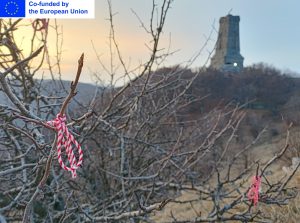
“Baba Marta Day” is the 1st of March and is a Bulgarian and Macedonian tradition to welcome the Spring.
In Bulgarian folklore, Baba Marta is a grumpy old lady whose mood swings very rapidly, as March’s weather. People ask Baba Marta for mercy to make winter pass faster and bring spring.
“Martenitsa” is the symbol of this event. It’s a small piece of adornment, made of white and red yarn, usually in the form of two dolls, a white male and a red female. It is a gift to loved ones and friends.
It is worn pinned to clothing or around the wrist or the neck, until the wearer first sees a stork, swallow, or blossoming tree (or until the end of March, the 1st of April). It’s the evidence that Baba Marta is in a good mood and is about to retire.
So, some people tie the “Martenitsa” on a branch of a fruit tree, thus giving the tree health and luck. Others put it under a stone: a creature (usually an insect) closest to the token the next day will determine the person’s health for the rest of the year.
If the creature is a larva or a worm, the coming year will be healthy and full of success. If it’s an ant, the person will have to work hard to reach success. Finally, if the creature is a spider, then the person is in trouble. That’s interesting, because in Italy, my country, spiders are associated to good luck.
This costum dates back to the 9th century: it has indeed Thracian (paleo-Balkan), Hellenic or Roman origins. Some ethnographers claim that it can be traced in the Eleusinian Mysteries.
From ancient times to nowadays, Baba Marta keeps accompanying Bulgarian people in their transition to Spring.