
In the monastery “La Maison de l’Inspir” in France I read the following sentence by Thích Nhất Hạnh on a wall:
“To be or not to be. That is not the question.”

This statement is linked to the Buddhist principle of interdependent arising. This concerns the idea of inter-being, so that everything depends for its existence on everything else. Everything “inter-is” with everything else, or “to be is to inter-be.”
Indeed, as humans we are part of Nature, so we inter-be among plants, animals and other people. And the most important being we rely on are the bees.
We depend on these flying insects: the Italian Institute for Environmental Protection and Research[1] reported that “they are responsible for about 70% of the pollination of all living plant species on the planet and provide about 35% of global food production”.
“A spectre is haunting Europe”, would say Karl Marx: it’s the spectre of extinction.
In this regard, “more than 40% of invertebrate species, especially bees and butterflies, which provide pollination, are threatened with extinction; in Europe in particular, 9.2% of European bee species are currently threatened with extinction (IUCN, 2015)”.
The end of the bees would mean the end of a multitude of plant species and the need of spiraling costs for artificial pollination.
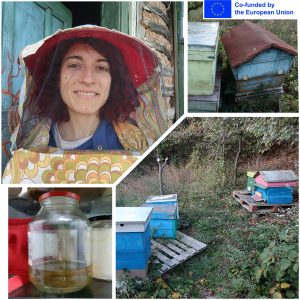
Good news is that we can help to preserve them. This is why I’m glad to have the opportunity to feed the bees with a liquid mixture of glucose and fructose at “Vegetarium”, obtained from millet grains and enzymes.
We are one with the bees and Nature: let’s bee helpful and protect them.
[1] Istituto Superiore per la Protezione e la Ricerca Ambientale (ISPRA).